
Some Personal Observations on Long Island Wine’s 40th Anniversary
Photo Courtesy of Long Island Wine Council
This year Long Island wine is celebrating the 40th anniversary of the first vinifera grape plantings by Louisa and Alex Hargrave that kicked off the Long Island wine region. As one who arrived very late to Long Island Wine some ten years ago, my perspective is somewhat different than that of the wine professionals and writers who have watched the evolution of wine making on Long Island over the past 40 years and the establishment of a solid wine region that today is acknowledged as producing both outstanding and unique wines.
Although I was raised and educated in Northeastern Pennsylvania, and was familiar with wine production in the Fingers Lakes region, I was not introduced to Long Island Wine until we moved to New York in 2003. For the previous 30 years, I was either travelling consistently for business to California from the East Coast, or after moving to California in 1982 living there for 20 years and learning about wine from a West Coast perspective.
As I am not a wine professional but rather a wine enthusiast. California became my frame of reference for domestic wine, and how it compared to traditional European wines. When I went to California in the 1970s it was all about Napa and Sonoma, particularly after California wines proved to be at least the equal of great European wines in a series of wine competitions. By the 1980s it was about the emerging West Coast wine regions that — like Long Island — began in the early 1970s. New vineyards had been planted from Santa Barbara, up the Central Coast to Paso Robles, to Monterey, to Santa Cruz, along the Sonoma Coast to Mendocino, and up to the Willamette Valley of Oregon.
Very much like Long Island, each of these regions experimented with multiple varieties and by the late 1980s to early 1990s each of these West Coast regions began to focus on one or two grapes or styles. Santa Barbara’s Santa Ynez Valley, with a hotter climate, found chardonnay and Southern Rhone varieties were a good match, while the cooler Sta. Rita Hills and Santa Maria regions focused on cool-climate pinot noir and lean chardonnay. Further North in the Paso Robles hotter regions, zinfandel became the grape, while in cooler portions of that region Southern Rhone grapes were selected, as they were in Southern Monterrey The cooler Santa Lucia Highlands of the Carmel Valley selected pinot noir, as did Santa Cruz and the Sonoma Coastal wine regions. In Mendocino’s cool climate white varieties were the predominate wines. In Oregon’s Willamette Valley, pinot noir was the main vareity although cool-climate whites such as pinot blanc, pinot gris and riesling were being planted and producing excellent wines. Later Washington State focused on riesling in the cooler Colombia River region, while merlot and cabernet sauvignon were the main grapes in the hotter Walla Walla wine region.
When I began to explore the Long Island wine region starting in 2003, there were a number of surprises — some positive and some less so.
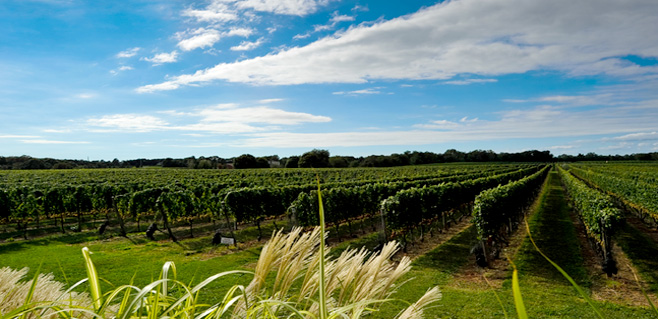
First, while not really knowing the history of Long Island viticulture, I was overwhelmed by the beautiful vineyards found on the East End. It was clear that there were serious proprietors and vineyard managers who invested in developing outstanding vineyards. Unlike the developing West Coast wine regions that were located on hillsides, Long Island was more like the Napa Valley with broad flat vineyards. Second, I was impressed with the number of substantial wineries and large attractive tasting rooms. The newer West Coast wine regions, unlike established Napa and Sonoma regions, tended to have far fewer fully equipped wineries and far less extensive tasting rooms. And of course I found the leaner more European-style red wines to be very appealing, particularly in comparison to the big, fruity and high alcohol wines from Napa and Sonoma.
Ten years ago there were some disappointments. My biggest problem back then was the big variation in quality between the top producers and the lower-tier producers, and quality issues in certain wines, particularly whites, from both top and lesser producers. I had just not experienced such major variation in quality on the West Coast — especially given that Long Island wines, as they remain today, were priced at the upper levels of the domestic wine price range.
My second problem ten years ago was that after finding great wines at the wineries, when I went back to Manhattan, it was difficult or impossible to find the wines being sold at wine stores. Not only could I not buy in Manhattan, I could not have friends in Pennsylvania or California also experience the wines I was enjoying.
Another issue with the Long Island wine region was — unlike the developing West Coast regions — there did not seem to be a distinctive variety that identified Long Island Wine. Ten years ago Long Island seemed to be continuing to experiment with many grapes and many winemaking styles, including some that were not well suited.
By 2006 when we purchased a house on the East End, I was completely committed to the land, the winemaking and wine of Long Island. The wine cellar at our house was quickly filled with the best wines I could find at wineries and local retail stores. I seriously considered investing in a vineyard, and becoming an active member of the Long Island wine community. I was fortunate to be introduced to top winemakers and proprietors and eagerly took on a role at the Long Island Merlot Alliance (now Merliance) in 2008 as I had concluded merlot and merlot-based blends represented the best of Long Island.
After two years back in the aerospace industry, when in 2011 I returned to New York I was pleased to find that Long Island wine remained robust during difficult economic times. New wineries, new brands and new approaches were being pursued. While no one variety has emerged as defining Long Island wine, there do appear to be positive trends.
Fortunately the issue of wine quality has significantly improved in the ten years I have been observing Long Island wine, although it is far from completely solved. As the lowest quality producer or wine remains the weakest link in the reputation of the a wine region, it seems to me to be important that the collective of Long Island wine ensures that all wine being produced is of high quality. Unfortunately, as consumer interest in merlot remains low, one of Long Island’s strengths has had a run of bad luck. But as leaner, lower alcohol, aromatic wines are popular with consumers, Long Island is well positioned with it maritime climate. As a top winemaker has said, “Long Island does not have adjust to make these wines; it is what we have always made.”
A number of white varietals and in particular white blends, sparkling wines and rosés are increasingly being seen as the potential defining wines of Long Island.
Distribution is also improving, but in my opinion has far to go. Yes, today it is much easier to buy Long Island wines in Manhattan and throughout the greater New York area, but try to buy Long Island wine in Philadelphia, or San Francisco, or Portland. Fortunately, wine shipment regulations have improved and it is now possible to ship wine to many of these locations. And in addition to distribution, price remains an issue, While I know firsthand how expensive Long Island vineyard land is, how expensive productions costs are, these costs are as high or higher on the West Coast, and there are far more lower priced California, Oregon and Washington wines in the marketplace than there are Long Island wines. This remains a major challenge.
Congratulations to all those that are and have been engaged in Long Island Wine over the past 40 years, The progress has been great and the potential remains even greater.


Len,
To summarize, your views of Long Island wines have to do with the following:
- There is/are some low quality wine still produced
- They are more expensive than California wines and price is an issue
- Not yet focused on a single or few varieties
- Limited distributions
These are presented with a point of view that shows them as weaknesses.
1. Can you site one wine region that does not have weaker producers? And if you cannot why hold LI to a different standard?
2. There are good CA wines that are less expensive that LI wines. There are good CA wines that are more expensive than LI wines. There are not so good CA wines that are more expensive than LI wines. There are also not so good CA wines that are less expensive than LI wines. The bottom line is that what happen in CA has nothing to do with the price of LI wines. In a market economy, the price is high if it prevents the sale of the product. Do you know many LI wineries that are hoarding wine? If we are selling out of our wines, the market says there is equilibrium as far as the price is concerned. Therefore it is not a valid issue that you bring up. Of course we all would like everything that we buy to be less expensive. But that is a fantasy.
Furthermore in blind tasting after bind tasting LI wines show better than wines that are priced much higher. Another indicator that price is not the problem you make it to be.
3. You lament that LI has not yet focused on a single or a few varieties. Why is it that fewer varieties are a good thing? If this was a succesful model for LI the merlot Alliance would be a little less irrelevant today.
How many varieties are grown in Bordeaux, the Loire, the Rhone Valley, Alsace and the various Italian regions? Perhaps not as many as are grown on LI but certainly many more than 2 or 3. In fact it can be argued that it is a strength of LI that it can successfuully grow so many varieties. Many wine regions may not be so lucky.
By the way our customers seem to enjoy the diversity and it is not unusual to see a couple liking different varieties and we are happy to be able to satisfy them both at the same time.
4. As to distribution, indeed we may never be able to distribute beyond our local market, because our local market is huge with over 10 million people between NYC, Suffolk and Nassau. But we do not see this as a weakness or a challenge. In the wine world there are small regions and large regions and they cohabit together happily. I do not see why in the case of LI it is a challenge.
Len,
Your glass is half empty! Drink up. You might see a happier picture.
Charles
Charles
As always you remain a strong defender of Long Island wine.
Likewise I have promoted and defended Long Island Wine not only locally, but to doubters outside the New York area.
And my glass is nearly full with Long Island wine.
To address your points:
1. The number one area I have had to defend Long Island wine is in response to the criticism from wine professionals outside the area that they assess there is a far too wide of a difference in the quality of the Long Island wine. I know that many Long Island winemakers and winery proprietors are passionately dedicated to quality at their winery. Further, the Long Island Wine Council, Merliance, and most recently the Long Island Sustainable Wine Growing not-for-profit organization all have quality as one of their key objectives. However, the outside the region professional observers say that they do not sense a compelling commitment of all of Long Island wine industry to overall Long Island wine quality. Do other wine regions have lower quality producers? Yes of course, but many actively do something to mitigate the damage to the reputation of the region. In a discussion I had with one of Oregon’s wine founders and proprietor of a world class winery, he said that the reputation of a wine region is derived not only by the quality of the top tier wines, winemakers and wineries, but also by the quality of the lowest tier wines, winemakers and wineries. Therefore, for years the Willamette Valley has been organizing cooperative programs, run by top and middle tier wineries, vineyard managers and winemakers, and designed to assist the lower tier to gain the vineyard and cellar knowledge necessary to produce great wines. The results have been promising as today the lowest tier $10 Oregon pinot noir blends are routinely rated 87+ by those that score wines. Similar efforts exist in other regions.
2. As all wineries, except perhaps a few run by monasteries in Europe, are for profit businesses and as such each establishes a business model that works. You are correct, if Long Island wineries can routinely charge $25 for a bottle of wine that sells nationally for an average of $15 and sell out annually, then that maximizes profits. What is does also do is open Long Island to the criticism that its wines are expensive. And it is difficult to defend against this criticism other than respond that while Long Island production costs are as high or higher than they are elsewhere, and Long Island wineries indeed do charge higher prices than other regions and will continue to do so as long as they continue to sell their wine. While that argument may not be great for the reputation of the wine region, it unfortunately also does reinforce the sometimes stereotype that Long Island wineries are no more than the play toys of Wall Street financiers.
3. We will continue to disagree on the value of Long Island varietal diversity as a keystone to the reputation of the region, versus focusing on one or two varietals or styles to define the region. It is interesting to note that the New York wines selected for the Inaugural Luncheon were the 2009 Bedell Cellars Merlot from Long Island, along with the 2010 Tierce Dry Riesling from the Finger Lakes, both wines that define these New York wine regions.
4. The lack of national distribution remains the one area that I simply cannot defend Long Island wine because I still cannot understand the business case. As you write, demand drives sales and prices. Yet uniformly Long Island wineries appear to not want to distribute their wines nationally to develop a larger market and larger demand. Yes I understand the positions of a) why distribute when you can sell everything locally, and b) why wholesale when you can sell retail in your own tasting room. But why not also distribute premium wines nationally and achieve even higher prices with increased demand. As an example, a winery general manager in Oregon confirmed comments made by a winery business manager from the Sonoma Coast who told me that their winery wholesales and distributes approximately 30 percent of their wine. Initially, revenue took a hit as they could have retailed the wine at 50 percent higher prices in their tasting room, but after only a few years of distributing the wine and receiving critical acclaim, not only in the wine media but also from wine directors and sommeliers, the winery has been able to raise prices to a point to not only recovered the lost revenues but has also increased their annual revenue with this 30/70 business model of wholesale/retail sales. Also they now have national recognition.
Len
Len,
There you go again. You want for reasons that are not clear, that Long Island fits your preferred model of what a region should be. Fine. But get over it. Long Island wines are getting great reception in some of the best restaurants in NYC, which have some of the toughest professionals as their wine buyers. And to repeat one more time, if the wines are selling then the price does not appear to be the issue you make it for those who are buying. Of course as previously stated we all like for everything to be less expensive but again this is a fantasy. And while you acknowledge that we farm in perhaps the most expensive part of the world, you do not make any allowance for that in your price discussion. The prices will be what the producers need to sell at to break even or better if they can. If that does not work then they go out of business. And some have.
And for those weak producers you fault the industry for not finding a way to lift them to a better place. What else is on your wish list that would further make us look like we do not know what we are doing? What is wrong with letting the buying public weed out the mediocre producers?
As to ratings we could spend time on that. However the ultimate rating is the one we get from our customers. If they like our wine they buy it. If they buy it they must find it to be a good value. And as stated above they include some very tough professional buyers. So all your analysis does not take these fundamentals into consideration and is not very useful therefore.
As to national distribution you make it sound like we are failing at something while many others envy us for being so well represented in what is the most coveted and difficult marketplace in the world, NYC. So what if we do not achieve national distribution? Orgon does not have anywhere near its vineyard a market such as NYC. For them it is not a concession to distribute nationally as you make it sound but perhaps it is the only way they can survive, as they need a larger market. However the spin seems to work on some.
Len,
You are entitled to your opinions but that is what they are, opinions.
I think one of the most important questions unanswered by this dynamic intercourse I’m reading here is about the distribution. We are pretending that our (LI wineries) lack of distribution is a choice. It is absolutely not a choice. It is true that we as a group have dabbled in CT and FL and stuck a toe in OH and a little in NJ – but even the greatest of LI wineries can’t (with a straight face anyway) tell you they’ve found real honest to goodness acceptance in NJ or any other place outside of the immediate area.
We want distribution and we should strive to get it, but don’t pretend for a minute that we can just take it like it’s low hanging fruit. It’s well known by now that I have found (literally) 100 times more interest in our wines in Shanghai than in Hartford or Hoboken.
The modern day distributor of fine and not-so-fine wines is being led around by the nose by one or more of the six mega-producers of wine and spirits. This leaves precious little attention time left for NY wines in, say, Kentucky and Missouri, when they have their own local wineries to distribute. Even then, the local distributor is merely “obliged” to handle their state’s producers.
There is no demand, none whatsoever, for LI wines 100 miles beyond the George Washington Bridge, except by collectors of curiosities.
I have, in previous posts and op-eds here on NYCR, espoused the importance of distribution – brow beating my peers to seek the kind of distribution I have enjoyed in the past…but I can’t ignore the fact that the distribution of wine in this country seems to have taken a very steep turn toward the mass produced brands who are far better at applying pressure(s) to the distributors than we are. Our heroes, those small distributors of the finest wines, with the finest client lists, are busy exploring Greece and Portugal – for what? For values, that’s what. For wine-by-the-glass. For exotic, for the next big thing. The next big thing, we ain’t…so now what?
Long Island has a LONG way to go in the national wine industry. The wines are largely flabby, lacking flavor, and way overpriced for the quality a consumer receives. Yes, farming grapes is an expensive endeavor around these parts, but if you’re going to have a 30 dollar bottle of cab franc, it better be top notch. Unfortunately, the quality of winemaking found on Long Island can be easily matched by multiple other regions at 12-17 dollars. Too many wines on LI cost 20, 25+, and they aren’t anything past “pretty good.”
If LI wants to remain a serious competitor in the wine world, it would be wise of them to stop producing flabby, flat, boring wines that lack structure, fruit, and complexity. I’m a long time East End resident, and I’ve had my fill of boring wines that cost 22.95.
I guess someone broke out his Robert Palmer handbook for that cliched description of LI wines
Even more disappointing is that this comment was written by Conor Harrigan, an employee of Duck Walk Vineyards on the North Fork.
Price, Mr. Harrigan is an irrelevant aspect to wine appreciation. The truly acendant understand that to be a fact. For whatever price you might place on quality, no region but LI can produce a LI wine. That, in and of itself, is enough to disprove any value proposition you are suggesting. When only you can create a certain type, there is not equivilency from other regions, and not at any price.
Damianos is going to freak out when he sees this…!
That explains somewhat his description of Long Island wines.
I guess one can’t criticize the industry in which he works.
Mr Covey, how is what I’ve said “cliche”?
You can, in your respective idolatries of this region, say that the wines are just fantastic, but it doesn’t hold up to facts. For the price points on this island, Long Island wines leave a lot to be desired.
Sure, many of them taste good, but how can an average consumer justify the price points on these wines when they can shop in other regions and find comparable, if not superior, wines at better prices?
Fact is, it is expensive to make wine in this region, and if we are gonna sell wines at 20/30/40 dollars a bottle, they better be KNOCKOUT. If you think they are, you simply don’t have a palate.
Conor,
I don’t think anyone is saying you can be critical of the region you work in. Long Island wine faces many challenges — and has since its inception — but your comment isn’t a balanced, thoughtful critique of the region or the wines.
I don’t know you well enough to know your palate or preferred styles, but it seems to me that maybe you just don’t like Long Island wines — which is fine — but to pan them the way you have is very closed minded.
For a great many people — myself included — drinking local isn’t just about the best values. It’s also about supporting local agriculture.
I’d love to know what you drink on a daily basis though. What are the wines at 20, 30 and 40 bucks that you drink most often that are “knockout” in your mind?
Conor,
It’s cliched because of the nature of the comment, the use of a “descriptive” language that is used by people who want to attempt to prove they are more knowledgeable than others.
It’s also mostly a redundant commentary because saying a wine is “flabby” and saying it is “lack(ing) structure” is the same thing in the Parker world of wine description.
Obviously I feel that there are producers on the Island making knockout wines at the 20+ price point but then I’m obviously just a hick from the bottom of the world with an uneducated palate.
And lastly, it’s this type of “can’t go wrong” attitude that will stunt improvement in this region.
Best,
Conor
What do you think needs to happen so that improvement can be made?
BTW, I know very few people in the local wine industry who blindly think everything is hunky dory. I see improvement with every vintage.
Perhaps there may be more forward progression when needy egos become irrelevant in the LI Wine Industry. Let’s understand clearly & frankly understand our challenges, shortcomings and strengths, and collectively move forward. And let not our consumer witness this childish self serving banter on these boards. Enough.
Jim, you as someone who is – questionably now – seen as a leader in the industry, I am disappointed by the lack of integrity behind your recent string of comments. You would maintain more respect in a productive silence.
Really? I thought my comments were measured and thoughtful…guess you can’t please everybody…
Dianne, do you work in the local industry?
Challenging a colleague’s integrity anonymously is unprofessional at best.
Ten to one it’s Dianne Delaney of Comtesse Therese.
Pricing is related to size and quality. Bulk wine producers in California and around the world have an edge in purchasing materials like bottles, corks, etc that lower their input costs. Their vineyard practices are tuned to the price point. While I am a west coaster (NY’s west coast) and visit LI occasionally, the impression I have of the overall goal of the LI region is to focus on quality vineyard and wine making practices, rather than bulk wines that are often laden with additives or sugar. There are plenty of examples of this model from California – and their price points are higher, starting at $50.
So I have to know – is Conor still at Duck Walk?
Duncan,
I agree Long Island is working on making more quality wines and make some good wines, even know they are at a drastic disadvantage when it comes to farming and farming costs.
“rather than bulk wines that are often laden with additives or sugar”
Well in CA unlike NY it is illegal to add cane or beet sugar (unnatural) to wine You must add grape concentrate a much more natural approach. Also what other additives do they add in CA that we don’t add on Long Island? I think you add more additives and chemicals on east coast then you will ever have in a CA wine.
Cheers,
Edward
Edward,
I was trying to illustrate that LI is likely not going after the bulk market, in a similar fashion to a large number of California wineries that also have a focus on quality. There is a large market for bulk produced wines that are often 2% residual sugar and up from there. These products tend to be less expensive, and laden with more chemicals like fining agents, flavor agents and sorbates to inhibit re-fermentation. Don’t get me started on chocolate infused or other “infused” concoctions!
I think many NY producers who focus on an artisanal product from the vineyard to the bottle are only at a disadvantage when compared to these bulk products in price. When you compare to similar quality products, NY wines can hold there own and provide exceptional value.
Nice info here on the long list of additives that are legal in the USA in 2010. http://www.alicefeiring.com/blog/2010/11/-approved-wine-additives.html
This list doesn’t cover the infusions, like raspberry or chocolate, which are all the rage in bulk sweet products.
Duncan,
Long Island is not going after the “Bulk Market” simply because they can’t. California is growing more and more grapes every year and making more and more wine and money. California is going to double amount of acres by 2025. Lets see how much LI grows in the next 12 years. If I was a betting man I would say it will have less planted grapes then compared to now. Plus go in to your nearest seven eleven or IGA and look at that wine product made on LI.
Edward
Ugh…Some of these comments are very disheartening. The lack of humility especially.
“Long Island wines are getting great reception in some of the best restaurants in NYC, which have some of the toughest professionals as their wine buyers.”
uh not quite Charles.
Other than a few placements here and there to satisfy the whole “local” and “farm to table” trend, I really don’t see Long Island wines taking up much real estate on NYC wine lists. But maybe that’s because us NYC’ers are a bunch of snobs who only want the trendy wines on our fancy shmancy wine lists, right?
“Oregon does not have anywhere near its vineyard a market such as NYC. For them it is not a concession to distribute nationally as you make it sound but perhaps it is the only way they can survive, as they need a larger market”
Charles, have you been to restaurants in the Willamette Valley or in and around Portland? The wine lists are LARGELY local. I can’t think of any NY area restaurants with a mostly local wine list. Why?
“Obviously I feel that there are producers on the Island making knockout wines at the 20+ price point but then I’m obviously just a hick from the bottom of the world with an uneducated palate.”
Well Matt, with the whole (Insert long southern drawl) “Ya think yer better than me!” attitude that is being displayed on this board…maybe you are.
Obviously anyone who criticizes long island wine is a snobby Robert Parker apostle! Hilarious.
It’s also pretty funny/Ironic that the “Merliance” is being called out as “irrelevant” and at the same time Robert Parker is being brought up.
As an NYC wine buyer I hear these critiques that Mr. Dest has brought up echoed over and over by many fellow colleagues. I do believe they carry some weight and this isn’t just a matter of us “city folk” being out of touch.
It’s interesting to hear that perhaps, in general, LI wines are struggling to get on top NYC lists.
Perhaps sommeliers aren’t being shown the best?
Perhaps, although I don’t know the taxation and general expected margins in USA/NY, some wines cannot compete on price with similar styles from other regions?
We’ve found in the UK that the fact that wines are small production can play a part in buyers understanding why perhaps the price could be a little higher. They also in general understand the cost of buying from the US and importing to the UK.
Most buyers understand that NY is NY, its not CA, its not Australia, it should be taken on its own merit.
A unique appeal of NY wine, or at least the wine we sell is that, they are hard to define, on the palate as new world, or old world, but are almost a bridge between the two.
Its quite sad to hear that more restaurants aren’t listing ‘local’ wines over there, it would be good to figure out where the stumbling blocks are.